Want to know a (dirty) little secret? Having a hot sex life is the key to making more money.
Yes. You read that right. That was a full stop.
A powerhouse female client of mine recently leaned in close to me over a chai tea latte and said with a sly smile, “The best sex my partner and I ever had was when he brought that dominant part of himself into the bedroom you had been working with on. I’ve never seen him like that, he was a fully embodied animal! I had no choice but to yield and be ravished by this powerful masculine side of him. I’ve never done anything quite like that before. And I f*cking loved it!”
I hear feedback like this from clients all the time. In opening up their sexual horizons together, the couples I work with find new levels of fulfillment and ignited passion in their relationship. Minds and bodies are blown. They tell me they feel more confident, open and free. But what they never suspect is that by cultivating the sex life of their dreams they also catalyze a paradigm shift in their businesses.
This is not an accident.
When I say your big breakthrough in business originates in a hot sex life, I mean it. The sexual alchemy you and your partner create together translates into financial abundance with precision and speed. And I’m going to show you the three ways to do it. But first, a little background:
Hacking Your Erotic Source Code
Sexual energy is arguably one of the most powerful yet often squandered forces known to man.
If you take a look at psychologist Abraham Maslow’s theory of the hierarchy of needs and align his model with our seven human energy centers (chakras), the sexual center is located directly above meeting our basic survival needs on the climb to self-actualization. Once we have a roof over our head, food and safety, the next thing we are wired to do is to go out on the prowl. We are hardwired to reproduce and carry on the human race.
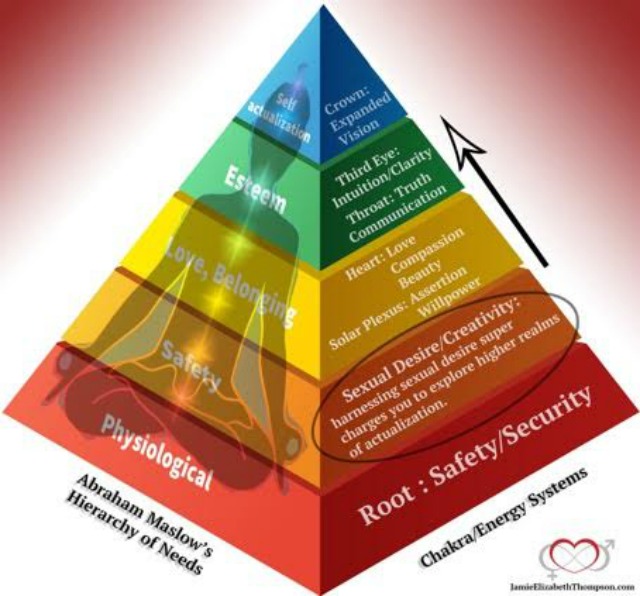
We can use this drive toward reproduction to our advantage in our businesses. At its energetic core, this drive is pure creative energy and can be used to manifest our life’s purpose in this physical plane. When erotic energy is harnessed, and we are getting our deepest sexual needs met, we experience an overflow of life force and power. We become channels for our unique divine purpose and can use this high vibration energy toward developing actualized communication skills, intuition, personal will and power, and emotional maturity, all of which are necessary to be in flow around money and earning.
In my work with high-achieving, growth-oriented couples I call this hacking your erotic source code. Take the Quiz to find out where your sexual superpower lies and where your area of growth is.
I want to help you become sexually awakened, fully self-expressed and shameless around your sexual desires. Just think how many billion-dollar shame-based industries would go out of business if more people operated from this point? And just think of how much room there would be for all of your paradigm-shifting, high-vibration businesses?
Exciting, no? Sexual energy is one of the most powerful forces in the universe. It’s either working for you or against you. You decide.
My Journey
Like many of us, I grew up with the programming that sexual desires, pleasure and exploration shouldn’t be talked about openly. For me, this programing was even more extreme and steeped in religious justifications. I heard, “Sex before marriage is shameful, and even when you do have sex, its purpose is to make babies. You can talk about the rest with your husband.”
But often we never do “talk about the rest” and have the in-depth conversations with our partners that matter, because there is no conscious adult erotic education to show us how it’s done.
I sat next to a very nice pilot from Chicago on an airplane yesterday, and as it goes when you sit next to me on an airplane, we got into a conversation about intimacy and desire in relationship. He said, “After eight years together I would have never even thought of bringing any of this up to my wife. I don’t even know how to do that… but now you have me thinking.”
Like this pilot, so many of us think about sex a lot, but feel confused or ashamed about our desires. We don’t know how to ask for what we want in bed because what we want is wrapped in layers of shame. We then settle for accepting less than what we desire and retreat into our fantasies while shutting down sexually with our partners. Resentments build, secrets are kept, and our creative life force drains out of us, affecting every aspect of our lives.
Let’s take a look at some of what happens when our sexual energy is shamed, repressed and misunderstood. I offer up parts of my own story as an example:
I’m five years old. I’m curious, vibrant and very connected to my body. I touch myself “down there” and it feels really amazing. Something doesn’t add up because touching myself feels good… but the world says it’s bad.
Now I’m sixteen years old. Old enough to feel like I don’t want to be a nun, I decide to give religion the finger. I rebel, and pick up sex as my drug of choice. I then spend my teens and early twenties cavorting around in cleavage crop tops and having sex for attention and validation. At first I think it’s cool, like I’m a badass rebel who can’t be contained.
What did that look like? Well…
My head is pounding. The fan above me is making an annoying buzzing noise. I think it’s Wednesday? This asshole next to me is snoring. I turn my head to look at said asshole’s face and am relieved to find that at least he’s cute, and I remember liking him. But why did I need to turn that into a hook-up? Where are my pants? How did I do this shit again? I can’t do this shit again.
It’s Saturday, I’m hungover from cheap tequila and existential emptiness in a room I don’t recognize. My chain belt and pleated battle skirt are off but this ridiculous Xena Warrior Princess top that puts my boobs up to my collar bones is still on. Fabulous. There’s a condom wrapper on the floor, thank God. But again, I don’t remember much at all. My phone vibrates, text from “Lumber Jack Shoreclub” What the actual f*ck is THIS? “Great time last night, had to work this Sunday. Call me sometime Xena. ;)” Oh. I’m in Lumber Jack Shoreclub’s bed. I do not remember this guys real name. *Throws up in mouth.*
I wake up over and over again in different versions of this same scenario. Each time, I find myself further out to sea, adrift in an ocean of my own unsatisfying, disconnected sexual indulgence. I have to stop. I really have to stop.
Finally, I see land! I swim toward it, desperate to connect to someone who can love me and stop this cycle. Perhaps it’s time to put that wild sexual appetite away in a box and trade it for domestication? Yes! That must be it.
I fall in love with a solid, sweet firefighter with dimples who I intuit will not hurt me. It’s the most loved and chosen I’ve felt in my whole life. He looks at me like I’m the only woman on the planet. We move in together. I play house.
The familiar feeling of guilt settles in my gut. It’s been three weeks since my sweet, loving partner and I had sex… and before that it was another three weeks. I don’t want to f*ck my boyfriend. WHY DON’T I WANT TO F*CK MY BOYFRIEND!?
I feel like there is still an insatiable sex panther in there somewhere. Something isn’t adding up. But the truth is, even with all the love in the world a sexual connection hasn’t really been there between us for two and a half years, no matter how much I wished it was. What’s wrong with me?
What was really happening to me? I carried shame about who I had been before, so I created a reality where my sexual needs were too much for my committed, loving partner. He rejected certain attempts and spicing it up and I took it personally instead of leaning in. I gathered evidence to support my story that I was too much for him sexually, and it was “adios libidos.” I was living a self-fulfilling prophecy of not being able to love and desire as guests in my house at the same time.
This is the cycle: Indulge/Act out – Repress/Shut down.
Many people are trapped in this cycle without realizing it because it’s so normalized in our culture. But normal doesn’t mean healthy.
When I was indulging and acting out sexually, my life force was activated but it was being wasted away without the alchemical process of cultivating sexual energy into magic. I was acting out unconsciously for attention without awareness of the impact of my behavior on myself and the people I was engaging with.
When I was repressing my sexual needs or shutting them down completely, I couldn’t hear what my channel was saying and my creativity was dulled. It was like I turned the dial down my own life force. I was dim. I was hiding my true self, thus preventing myself from accessing the deep love and abundance that is freely available to us all.
So What Did I Do Differently?
I wrote a new chapter of my life. I began treating sex as a sacred practice deserving of honor and respect. Your sex life is a microcosm of the macrocosm of your life. I discovered this firsthand when I went on a mission to stop apologizing for any aspect of myself as a sexual being.
- I began to eradicate sexual shame when I stopped judging myself for what turns me on and what doesn’t. I liked to ‘be bad’ so I gave myself permission to harness that energy in sex with a chosen partner in a way that was in alignment and fueled both of us.
- I voiced the nuance of the specific kind of touch and eye contact I like that I had written off as being complicated and sensitive.
- I began asking for what I wanted even if it might make someone uncomfortable. I let my softer side be known, the one who doesn’t always want it, but sometimes wants to just be present together instead. The one who speaks up when its not quite right, but opens to give adjustments.
- I claimed my vivacious, fiery sexuality with a foundation of integrity and alignment, allowing me to truly be taken and take when that’s what wanted to happen.
- Having sex became about allowing myself to be seen and exploring the depth of intimacy and connection that occurs when I show up in my full wild desire, sober, present and alive.
- I opened up a new ability to enter altered states of consciousness and experience God through sexual union. During this time, I channeled and created Erotic Wiring™, which is a new system for transforming your life through exploring your erotic self.
My unharnessed sexual desire existed as dead weight, stuck in my body, holding me back. Through my awakening, this potent energy store became the force and foundation upon which I built my business. I found the courage to quit the streams of income that were no longer in alignment with my newly discovered self and I replaced them with ones that were. Connections came to me in synchronistic ways and I began making more money from unexpected places. My thriving business, which has since shifted a couple more times, began to emerge.
Now, my hot sex life is a churning source of power, full of self-expression, play, and spirituality. I regularly ask myself the question, “Am I having the sex I want to be having?” and if the answer is no, I feel completely empowered to change that. The same goes when I ask myself, “Am I living the life I want to be living?”
The way I approach my hot sex life has blasted open my creative channel and empowered me to make more money while living my purpose.
Care to to join me?

Turn On Your Erotic Wiring™, Transform Your Life
Do you want to blow the lid off your sexual and business potential? Try the following:
1. Practice asking directly for what you truly desire with your partner.
It seems so simple, but are you doing it? Really?
Having our deepest desires witnessed by someone we love is incredibly vulnerable. If you want to increase intimacy and connection in your relationship, start by sharing what you really want that you are not saying. Knowing what you want and how to ask for it specifically and confidently is one of the greatest skills one can hone in business. If you feel scared, start with some “smaller” things to build a sense of trust and safety. The energy shift you experience will be enough to push you into the bigger asks.
I recently worked with a couple where the woman uncovered and finally voiced her desire to surrender completely to her partner. This felt weird and backward to her because both her and her partner viewed her as a powerful woman. Her partner, to her surprise, greeted her desire with open arms because he wanted to step more fully into his unapologetic masculine power. Consciously activating the masculine-feminine polarity in their relationship sky-rocketed their sex life and their careers soon followed. His business came out of a dry spell after a major re-direction and she tripled her income.
2. Practice the skills you want in life in the bedroom.
Turn your sex life into a practice court. I’m a big fan of playing beach volleyball. I sucked at setting, so I went to the beach and practiced. It was clunky at first but I got better and now I set that volleyball with precision!
Just like any skill, with practice in your erotic court, you can become a master of communication, opening your intuition, listening, owning your power, commanding a space, surrendering to flow and harnessing your energy. Plus, when you know how to navigate all the sections of the Erotic Menu™ you become a masterful lover in the process.
I look at my life and what needs to be balanced and I happily bring it to the bedroom to “work it out.” Being a purpose-driven, growth-oriented individual, this is the fulfillment of my dream. I have found an endless well of personal development that I can draw from.
3. Dance with your sex demons.
In Jungian psychology, the “shadow” is the part of ourselves that we don’t want to see and feel the most shame around. We separate off these shadow aspects and lock them up, not allowing them to be part of our conscious experience. But behind closed doors they haunt us, controlling our behavior whether we want them to or not.
If you feel bored or confused in your career, this is an indication to go deeper into conscious sexual exploration. What part of yourself are you afraid of seeing right now? Confusion and boredom are showing us it’s time to go deeper and access a new part of ourselves. Work it out on your erotic practice court!
Even when a secret desire seems like it’s really pushing the limits of common cultural taboos, often it isn’t even about what we think it is. We don’t know what’s in the dark room until we open the door and turn on a light. We don’t need to act on everything and it’s a good thing we don’t, but when we can face the truth of our desire we are free.
Here is your permission to open the door. Your hot sex life and business breakthrough are waiting.
Are you ready?
It’s really fun.
 Jamie Elizabeth Thompson is a Holistic Sex and Intimacy Coach with clients around the globe. She specializes in teaching impact-driven couples and individuals the tools to meet their sexual and intimacy needs and navigate challenges and conflict masterfully through open, loving communication. She refers to this practice as “intimate tai chi.”
Combining Jungian psychology, the Quantum Field, communication techniques based in neuroscience and non-dualism, and somatic movement reprogramming, Jamie uses her ten years of coaching experience to give her clients the safety and tools to harness their erotic intelligence and create empowered, purposeful lives with thriving intimate relationships.
Erotic Wiring™, is a transformational tool developed by Jamie to tease out what turns you on, what your sexual super powers are, and the unique erotic path that will help you attain optimum personal growth. By using the Erotic Menu™, you will receive a you-centered recipe for hot sex and deep intimacy that elevates your superpower for maximum impact in every aspect of your life.