
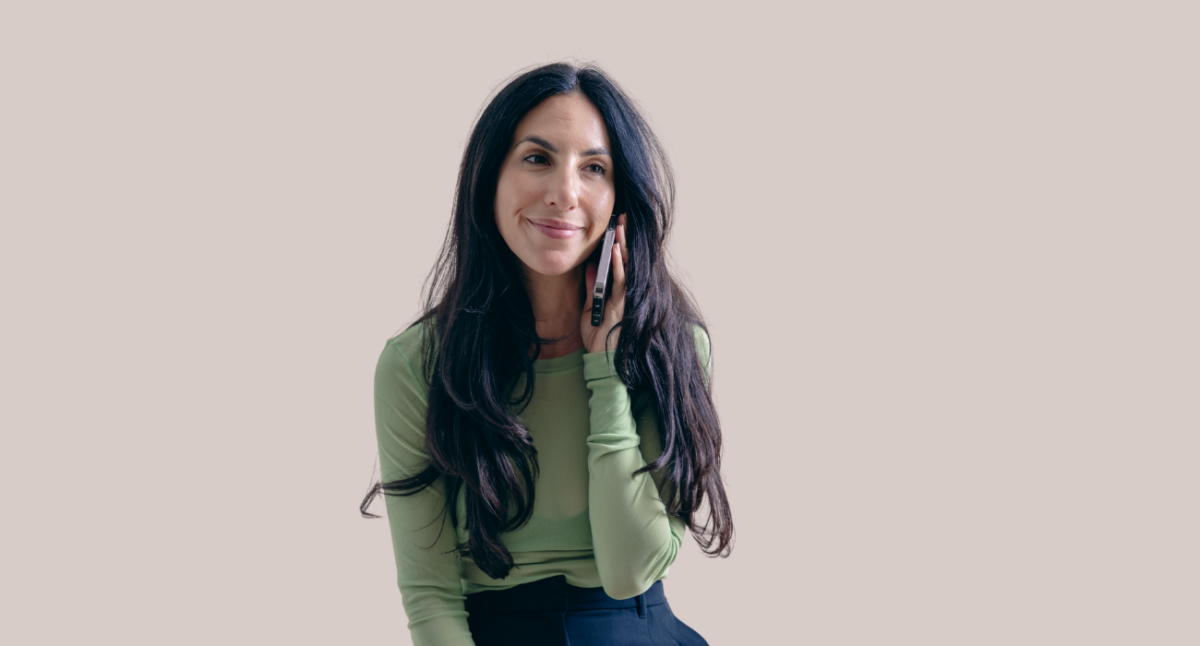
Ep. XXX: Why There Is No Formula for Building a Brand—or an Unconventional Life—with Arielle Tayar
From luxury events and global branding to artificial intelligence and the art of trusting your gut, Arielle Tayar has built her career by refusing to follow a single blueprint.
As the founder of Whip Creative Studio and Whip Productions, Tayar has spent the last decade working at the intersection of brand, story, experience, and human connection. Her work has crossed industries and continents, with a creative portfolio that includes major brands, high-profile events, and a global team of creatives.
Yet when Unconventional Life host Jules Schroeder introduces her by listing the many accomplishments that appear to define her career, Tayar has a surprisingly simple response.
“I’m winging it.”
For Tayar, that isn’t a confession of uncertainty. It is a philosophy.
She follows opportunities, creates opportunities, trusts her intuition, and allows her career to evolve rather than trying to force it into a predetermined shape. That mindset has become the foundation for both her businesses and the way she approaches branding itself.
The Woman Behind the Brands
Tayar’s creative instincts began long before Whip Creative Studio.
Raised in New Jersey by Israeli immigrant parents, she grew up as the eldest of four children in a family where entrepreneurship wasn’t an abstract career path—it was simply the world she knew.
Her parents were both entrepreneurs and business owners. She says she didn’t grow up seeing her parents report to bosses or follow a traditional corporate path. Instead, she grew up seeing people create their own opportunities and operate on their own terms.
That example had a lasting impact.
All four siblings eventually became business owners themselves.
Her father’s expectations also shaped her early identity. As the firstborn daughter in a Middle Eastern family, she recalls being told from an early age, “You are a businessman. You will be a businessman.”
What might have sounded like a simple expectation became something deeper: a belief that she was capable of creating something of her own.
That early confidence would eventually become one of the most important ingredients in her entrepreneurial life.
“The Guardrails Are Mostly Made Up”
When Schroeder asks what she has learned about creating your own path when the model in front of you isn’t clear, Tayar doesn’t offer a traditional business framework.
Instead, she points inward.
She believes much of the work is about developing an inner knowing and recognizing that many of the boundaries people perceive as immovable are actually constructed.
The boss who won’t approve the move.
The career path that seems predetermined.
The expectation that success has to look a certain way.
The belief that there is only one route to the destination.
Tayar’s point isn’t that real-world limitations don’t exist. Rather, she encourages people to question which limitations are genuinely fixed and which ones have simply become part of the story they tell themselves.
“Trust” becomes an important part of that process.
Once someone starts trusting themselves, she suggests, possibilities begin to expand.
The Power of a “Little Yes”
That philosophy is also reflected in the way Tayar approaches opportunities.
She doesn’t describe herself as someone who always knows exactly where she’s going. Instead, she is willing to respond to what appears in front of her.
That might mean saying yes to a new opportunity, reaching out to a new collaborator, or taking on a creative project before every detail has been figured out.
For Tayar, the path doesn’t necessarily have to be visible before you take the first step.
Sometimes, the next step creates the path.
It’s a philosophy that mirrors the unconventional life Schroeder has built her own podcast around: rather than waiting for certainty, you can begin moving and allow the journey to reveal what comes next.
When AI Isn’t the Answer
That willingness to experiment becomes particularly relevant when the conversation turns to artificial intelligence.
Schroeder and Tayar discuss the rapid evolution of AI and what it means for creativity, branding, and storytelling.
Tayar has watched her clients move quickly from excitement about AI to skepticism about it.
At the beginning of the year, some clients were eager to incorporate AI into their brands. Tayar was willing to experiment with them, testing what the technology could do.
But the enthusiasm didn’t last for everyone.
Some of those same clients eventually came back with a very different reaction: they didn’t want their brands to feel like AI brands.
For Tayar, the lesson isn’t that AI should be rejected.
It’s that AI needs to be understood for what it is: a tool.
AI can amplify creative work. It can help produce things. It can open new possibilities.
But it isn’t the story itself.
“If you want to have your brand or whatever you’re doing have strong intentional storytelling that’s really going to resonate,” Tayar explains, AI isn’t the mechanism that creates that human connection.
The technology is a means to an end—not the means to every end.
The More Artificial the World Becomes, the More Valuable Humanity Gets
This is where Tayar’s philosophy about branding becomes bigger than branding.
In an increasingly automated world, she sees a growing desire for things that feel personal.
Human.
Real.
That doesn’t mean technology and humanity have to compete.
Instead, the opportunity is to use technology without allowing it to replace the qualities that make a brand meaningful in the first place.
For Tayar, those qualities include storytelling, emotion, intuition, and connection.
Her work begins with the people behind the brand.
What are they trying to say?
Why does it matter?
Who are they trying to reach?
What should someone feel when they encounter them?
Those questions can’t simply be replaced by a tool.
They have to come from somewhere deeper.
Branding Has Left the Logo Behind
If branding used to be primarily about a logo, color palette, and typography, Tayar believes the modern brand identity has become much more layered.
Photography matters.
Video matters.
Editing matters.
Color grading matters.
The way content is framed matters.
Even subtle visual choices can become part of a recognizable identity.
Tayar points to color grading as an example. A person can scroll through an account and recognize a brand simply because of the way its videos are colored—even without immediately seeing the logo.
These details create consistency.
They establish personality.
And collectively, they tell people who a brand is.
The result is a much more sophisticated understanding of identity: branding isn’t simply what a company looks like. It is how the company consistently shows up.
There Is No Rinse-and-Repeat Formula
Perhaps the biggest misconception Tayar challenges is the idea that successful branding can be reduced to a formula.
She sees brands that are meticulously engineered.
She also sees brands that seem to emerge almost entirely through intuition.
Both can work.
So when someone asks her for the formula to make a brand successful, she doesn’t pretend to have one.
Instead, she wants to understand the person or company first.
What’s at the heart of what they’re trying to do?
What are they actually building?
Are they looking for a short-term spike in attention, or are they building something meant to last?
Those questions determine the strategy.
There may be tactics that generate money quickly, she acknowledges, but attention isn’t necessarily the same thing as longevity.
For Tayar, the deeper question is whether the brand can continue evolving without losing its identity.
A Brand Isn’t Finished When the Logo Is Done
Tayar compares a brand to a baby.
You don’t create it and walk away.
You cultivate it.
You feed it.
You dress it.
You watch it grow.
Then you do it again.
Her relationships with long-term clients reflect this philosophy. Some have worked with her for four or five years, allowing the creative team to watch the brand evolve over time rather than treating branding as a one-and-done project.
The brand changes.
The business changes.
The audience changes.
And the identity has to be able to grow with all of them.
Yet throughout that evolution, Tayar believes there is one thing that cannot be abandoned:
staying true to yourself.
What Happens When You Stop Looking for Authority?
By the end of the conversation, Tayar’s philosophy about branding has expanded into a philosophy about life.
When Schroeder asks her what living an unconventional life means to her, Tayar doesn’t hesitate.
“There are no rules.”
For her, the realization that nobody has everything figured out can be liberating.
Everyone is navigating.
Everyone is experimenting.
Everyone is trying to figure out what comes next.
Once you recognize that, the authority you may have unconsciously given to other people starts to disappear.
The person with the impressive title isn’t necessarily more certain than you.
The entrepreneur with the bigger company isn’t necessarily more qualified to determine what your life should look like.
The expert on the stage isn’t necessarily holding the secret formula.
Everyone, in some way, is winging it.
And perhaps that’s exactly what makes it possible to build something that is truly your own.
The Two-Hour Brand Makeover: Arielle Tayar’s Unconventional Life Giveaway
For one Unconventional Life listener, Tayar is offering a rare opportunity to experience her creative process firsthand.
The winner will receive a two-hour branding workshop with Arielle Tayar and one of her designers.
During the session, they will workshop the winner’s brand and create a mini brand identity, including:
Logo
Color palette
Typography
Photo language
And unlike a traditional branding engagement that can take weeks or months, Tayar says the goal is to create this mini identity during the two-hour session.
The giveaway is specifically designed for a small, up-and-coming business or brand that needs help bringing its identity to life.
Connect With Arielle:
- Website: https://www.whipcreativestudio.com/about
- Instagram: https://www.instagram.com/arielletayar/
- LinkedIn: https://www.linkedin.com/in/arielle-tayar-45430a61/