
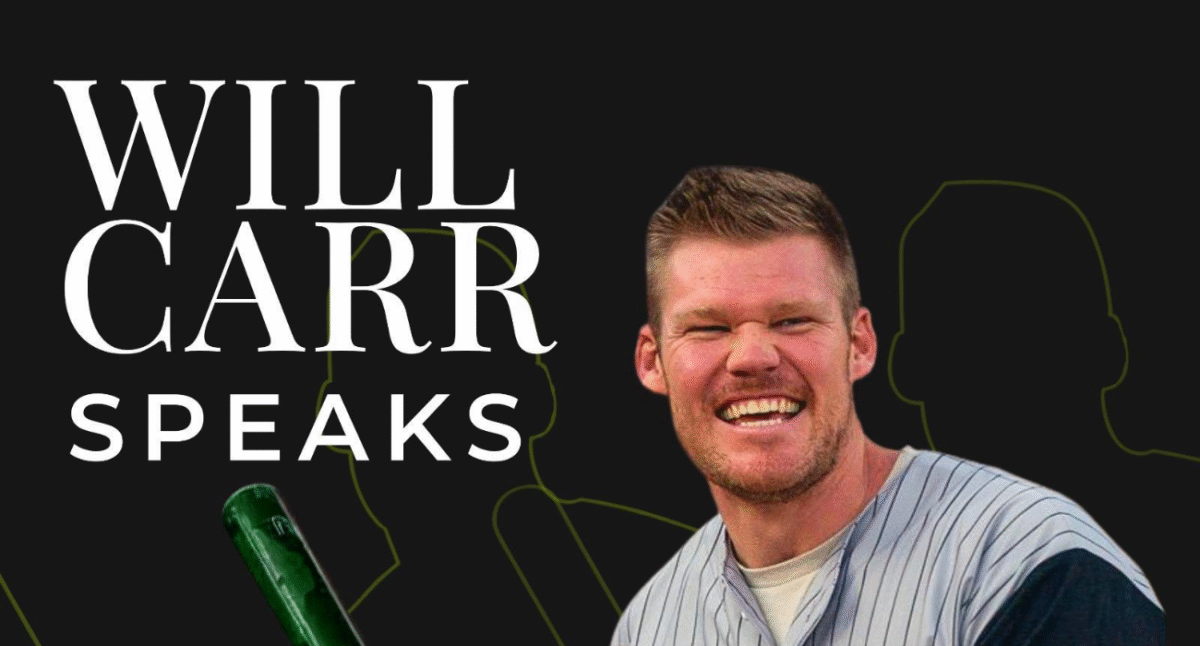
Will Carr doesn’t talk about grit like it’s a brand asset. He talks about it like a choice you make after impact.
“Are you going to pick yourself up when you get punched in the face?” he says early in his conversation. His answer is immediate: “Yep. And keep going.”
That isn’t justmotivational poster language for Carr. It’s lived experience, sharpened through sport, tested through entrepreneurship, and grounded in a faith that asks him to become the kind of person who can hold both the win and the wreckage.
A 6’11” Kid on a Corn Farm Who Learned Community Before Success
Carr is 6’11”, and he knows it’s the first detail people clock. But the more defining detail is where he grew up: rural Midwest, on a corn farm, in the pre-cellphone era where “going to play” meant hopping on a four-wheeler and trusting you’d find your way back home.
Sports didn’t become his outlet the way it does for many kids. For Carr, it became belonging.
It was how he spent time with his dad. How he connected with family. How he socialized when “neighbor” could mean a long country road away. Baseball was his first love. Basketball became the logical next chapter as he kept growing taller and taller, until the path was practically chosen for him.
He went on to play college basketball at Colorado School of Mines while studying engineering, and later played professionally overseas. Eventually, like every athlete learns, the clock runs out. The identity shifts. The built-in team disappears. And you find out what you’re made of when the uniform is gone.
Why Athletes Make Dangerous Entrepreneurs
Carr believes athleticism trains you for entrepreneurship in ways business school can’t replicate.
Athletes don’t just learn to win. They learn what losing is for.
“You learn to love to lose,” he says, because losing is where the data lives. It’s where you reflect, retool, and return sharper. Winning feels good, but it doesn’t force evolution.
In business, that mindset becomes a survival skill. You can lose nine out of ten times and still be the person who wins in the end—because the most successful people are often the ones who have failed the most.
Schroeder echoes this with her own story of extreme highs and lows in entrepreneurship and the “zones of turbulence” that show up right before a breakthrough. Success, she argues, requires capacity: the ability to hold the equal and opposite swing of challenge.
Carr offers an image from Taoist philosophy: the pendulum. Pull it high to one side, and it will swing hard to the other. The work isn’t eliminating the swing. The work is getting comfortable inside it—then finding the center.
Faith Without the Noise: “The Kingdom of God Is Within Us”
Schroeder asks Carr what people misunderstand about faith. His answer is direct: many people’s first exposure is organized religion—rules, dogma, shame, constant self-judgment.
Carr’s faith is more intimate than institutional.
For him, Christianity is about following Christ and remembering that “the kingdom of God is within us.” Not outward seeking. Not proving. Not performing. A connection already placed inside you.
From that lens, hardship becomes something you can hold differently. Carr speaks to gratitude in seasons most people rush to escape, because he believes in a simple but demanding idea: if anything in your life were different, everything would be different. The painful detours shape the entire map.
The Day a “Smart” Coupon Code Turned Into a $7,000 Punch in the Face
If Carr’s philosophy sounds calm, it’s because he’s paid for it.
Earlier in his entrepreneurial life, he ran a protein powder business. A manufacturer added the wrong ingredient into a batch—an error that made the inventory unsellable under the original brand. Carr signed off on it, so he treated the fallout as his responsibility.
He had 2,000 units he couldn’t move. So he did what entrepreneurs do: turned the problem into a product strategy.
He launched an Amazon-exclusive brand in a week—fast, scrappy, designed to offload the inventory and recoup costs. To speed up shipping for influencers, he created a 99% off code only he knew, then used it to buy his own product and let Amazon handle delivery.
It was clever. Until it wasn’t.
The coupon surfaced through a deals ecosystem connected to browser plugins like Honey, then got posted on a Facebook deals page. In two to three hours, Carr watched a “viral” spike in sales turn into a gut drop: strangers had cleaned out his inventory for pennies.
Amazon shipped everything. Then charged him roughly $7,000 for fulfillment.
The result: a financial hit, a hard lesson, and a moment that separates builders from dreamers.
“What are you gonna do?” Carr asks. “Are you gonna stop or are you going to pick yourself up when you get punched in the face?”
He doesn’t romanticize the pain. He acknowledges the emotional reality—sometimes you do need to feel it. But he refuses to live there.
Schroeder adds a practical take: if you fully allow a wave of emotion—no resisting, no numbing—you can move through a full emotional cycle quickly. The takeaway isn’t to bypass feelings. It’s to process them, then keep going.
Carr’s “win” from the disaster wasn’t money. It was capability: he learned he can launch a brand in a week. He learned what not to do next time. He learned that even a punch can become training.
Genesee Nutrition: A Protein Bar Built Like a Values Statement
Today, Carr is the founder of Genesee Nutrition, a company built around athletic performance, clean ingredients, and a philosophy of fuel that’s more foundational than trendy.
Genesee makes a grass-fed bison tallow-based protein bar, sweetened with raw honey. Carr calls it the only one of its kind on the market, with tallow as a standout ingredient because it provides nutrient-dense healthy fats.
He breaks down his food hierarchy simply:
-
Hydration first (he notes the body is largely water)
-
Protein next
-
Healthy fats to support the system
Genesee’s core ingredients reflect that:
-
Grass-fed bison tallow
-
Whey protein isolate
-
Collagen peptides
-
Organic peanut butter
-
Raw honey
The company also has an athletic footprint: Genesee is the official protein bar of the NJCAA, serving junior colleges across the U.S. Carr works closely with smaller athletic programs and speaks to college athletes about what happens next.
Because the career ends. Even for the few who go pro, it ends soon.
And then you have to answer the question most people avoid until it’s too late: Who am I without the sport?
The Real Business He’s In: Identity After the Jersey Comes Off
Carr loves fuel, performance, and competition. But his deeper mission is helping athletes translate discipline into adulthood.
He points out what often breaks after sports: community.
Team sports give you a built-in ecosystem—friends, structure, belonging, accountability. When that disappears, people scramble. Carr urges athletes to think ahead: What are you passionate about? How do you want your days to look? How will you build community on purpose?
For Carr, entrepreneurship didn’t replace sport. It extended the same hunger: to compete, improve, and create something real.
And underneath it all is a family-first orientation. Genesee is a small family business. He runs it with his cousin. He homeschools his daughter. He designs his life around the people he loves, not the optics.
Lifestyle Freedom, According to Will Carr: Cut the Unnecessary, Keep the Sacred
Schroeder introduces her concept of lifestyle freedom: money doesn’t automatically create time. Often, the structure you build to earn binds you—golden handcuffs disguised as success.
Carr’s advice is practical and almost stubbornly unglamorous:
-
Get crystal clear about what you want your life to look like.
-
Identify what you don’t need, and remove it.
He offers an example: he drives a 2012 Toyota Tundra with over 200,000 miles. He could buy a new truck. He doesn’t want the payment. Less debt means less required cash flow. Less required cash flow means more choices.
His philosophy is simple: the more you simplify, the more you can direct your life instead of financing a version of it you don’t even want.
The Unconventional Life, in One Sentence: Choose the Sacrifice That Buys You Back Your Life
Everything creates sacrifice. Either you sacrifice for the life you want, or you sacrifice the life you want for things you don’t need.
He pairs that with gratitude—no matter where you are in the journey. Not as toxic positivity, but as a stabilizer. A way of remembering what matters when society sells you a louder target.
Because you can have all the money in the world, Carr says, and still be crying in your Ferrari at night.
And to him, that’s not success.
Giveaway
This week’s giveaway is a two-part bundle:
-
Genesee Nutrition protein bars
-
A unicorn-themed coloring book created by Will’s daughter, Blakeley Darling
Bonus: If you don’t win the giveaway, you can use code “unconventional life” for 15% off on Genesee’s website.
Connect with Will:
-
Website: willcarrspeaks.com
-
Instagram: @willcarrspeaks
-
Blakeley’s coloring book is available via BlakeleyDarling.com